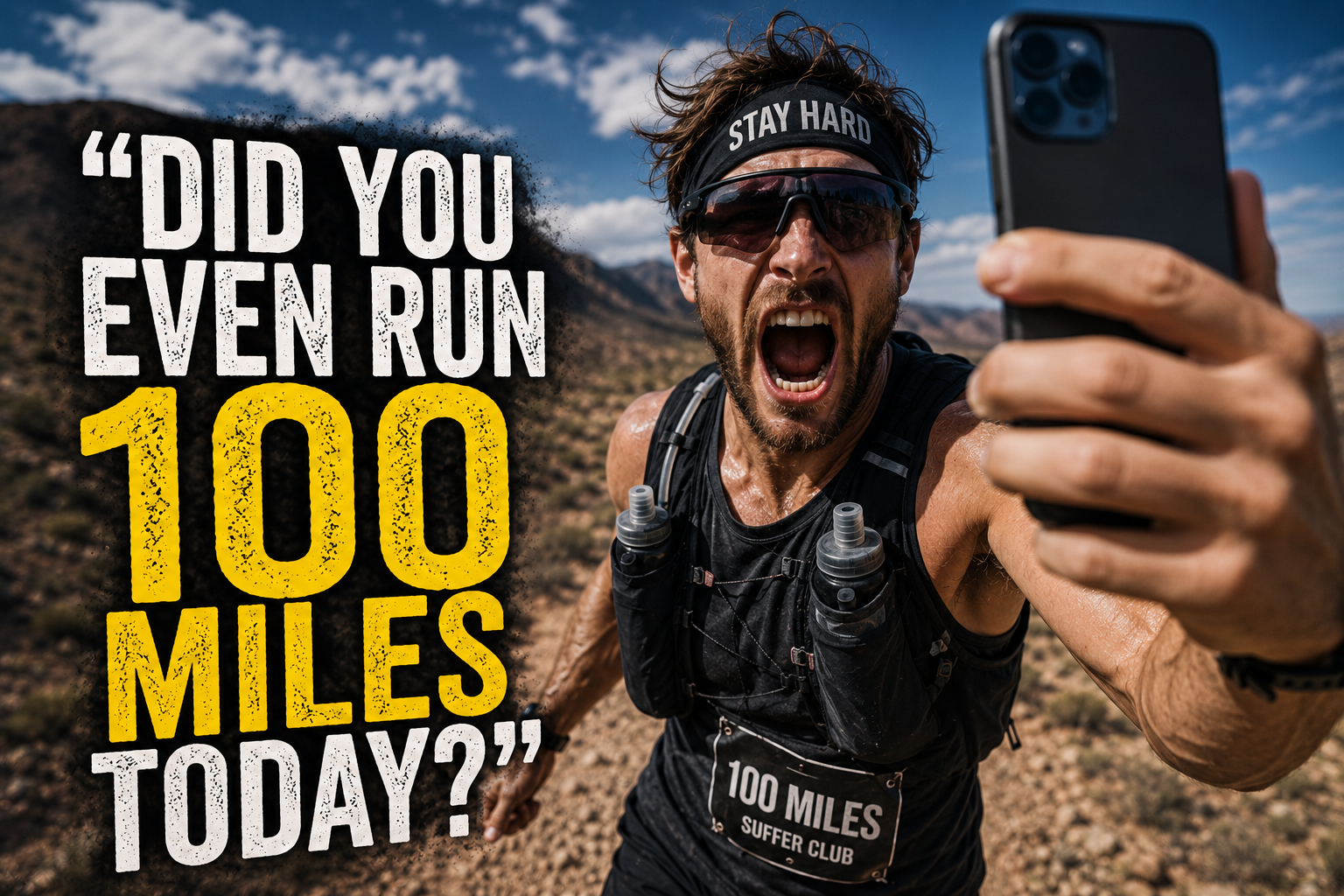
BREAKING NEWS: Running 100 or 200+ miles does not make someone a better human being.
Apparently, this now needs to be said out loud.
A strange genre of online ultra runner has emerged over the last few years. The kind who slowly begin treating mileage like a moral ranking system.
Not tougher in one specific area of life. Not more disciplined in endurance sports. Better. As humans.
I saw it again recently after a race. A guy dropped out. Maybe he could have gutted it out. Maybe he made the right call. That part is irrelevant to me. What caught my attention was that within hours he was on social media proclaiming he was still better than anyone who “didn’t even try” that race.
That particular race.
An oddly specific standard for human value, isn’t it?
What about the races he didn’t run that other people did? Are they better than him then? Does the hierarchy reset every weekend at packet pickup?
You see this pattern constantly with the running man fluencer crowd, wildly underperforming relative to their pre race proclamations, then immediately broadcasting lectures from Mount Ultra about courage, grit, suffering, and superiority over the civilians back home who spent their weekend doing something absurd like raising children, working overtime, caring for aging parents, or holding together an actual life outside a hydration vest.
Very inspiring.
I understand what is happening psychologically. Most adults do. Insecurity in a hydration vest. A man desperately trying to convince himself that suffering automatically equals significance.
I actually really like a lot of these guys in person. I share some of the same positive and negative traits they do. Cockiness. Bravado. The desire to prove something.
The difference is that I know much of this online “man fluencer” world is performance, highly curated personalities preaching authenticity while packaging every workout, hardship, and finish line into content for clicks, followers, engagement, and supplement codes.
Humans are messy.
But a lot of younger people watching this do not realize how much of it is theater.
Especially young boys and young men.
You can spot the “man fluencer” disciples from a mile away at races now. Loud slogans ready at all times. Every sentence sounds like a low budget motivational reel. Constant talk about “haters.” Completely unable to process even mild adversity without spiraling into excuses, blame shifting, or dramatic declarations about quitting social media forever until approximately Tuesday afternoon.
Wash. Rinse. Repeat.
I am not immune to some of this either.
Anyone who has known me long enough has probably seen me post some overly dramatic mid race clip where I act like making it to the next aid station is basically summiting Everest against impossible odds. We all pump ourselves up sometimes. We all create narratives in our own heads to survive difficult moments. There is something beautiful about that. Human beings have always needed stories to carry themselves through suffering.
And these influencers are not purely bad.
A lot of them have helped people lose weight, get outside, build discipline, and discover they are capable of more than they believed. Some young guy watching motivational clips instead of mindlessly scrolling nonsense all day is probably a net positive for society. This is not a zero sum conversation where people are either heroes or villains.
Like me.
Like you.
Like everyone else.
People are usually both.
I am writing about the bad part.
The part where self-improvement quietly mutates into self-worship. The part where suffering becomes branding. The part where some runners start believing mileage is a personality, or worse, a measure of human worth.
And relax people, this is not about David Goggins.
Goggins, for all his bravado and intensity, does not think he is better than people because he can run far. His actual message is more about that pushing your limits can make you a stronger version of yourself. That you have more to give. There is value in testing your perceived limits. There is value in voluntary hardship.
But somewhere along the way, a certain genre of internet endurance personalities took the aesthetic of suffering while missing the point entirely.
They copied the yelling.
They copied the slogans.
They copied the performative intensity.
They skipped the humility.
Now we have an entire ecosystem of people turning 100-mile races into personality cult auditions.
The irony is that some of the most impressive people in this sport are usually the quiet ones.
I will occasionally have people tell me how amazing it is that I run 100s or 200-mile races, and that they could never do it. It is kind. I appreciate it. I usually smile, nod, and say thank you.
Then I think about the single mother working 45 hours a week while somehow still getting her kids to soccer practice on time. I think about the father holding together a household while quietly carrying stress nobody sees. I think about people caring for sick parents, building businesses, surviving grief, or simply waking up every day and doing what must be done without needing strangers online to applaud them for it.
That is often far more impressive to me than jogging through the woods for two days while eating apple sauce packets and posting inspirational captions about “embracing the suck.”
I can run as far or farther than most of these influencers. Slower than some. Faster than some.
It just never once occurred to me that mileage somehow increased my value as a human being.
Nor do I feel lesser when someone runs farther than I do.
Because deep down, most emotionally healthy adults understand this already. Running is a skill. An interesting one. A difficult one. Sometimes even a beautiful one.
It is not a moral ranking system.
We should absolutely encourage young men to push themselves physically and mentally. Society often pushes the opposite message. Young men should get outside. Explore. Struggle. Build resilience. Learn discipline instead of spending every waking hour staring into glowing rectangles while being told comfort is the highest human virtue.
We do not need more beta men wandering around pretending the solution to every problem is a warm fuzzy group hug and a journaling circle fueled by herbal tea and unresolved childhood feelings.
Young men need challenge. Responsibility. Discipline. Purpose. Strong men matter.
But we also need to stop rewarding insecure performance art masquerading as wisdom.
Maybe stop handing sponsorships, race exemptions, and endless profiles to people simply because they make dramatic Instagram clips. Maybe stop confusing visibility with character. Maybe stop acting like the loudest person with the biggest following automatically represents the best parts of the sport.
Because running far does not make someone enlightened.
And it definitely does not make them better than anyone else.
The world already has enough men performing toughness.
It needs more men quietly living with depth, humility, and purpose.


