Over seven years ago, I wrote a blog post called How to Deal with Unresponsive Friends. Somehow, that post still gets more than 2,000 views per week. Which either means I accidentally wrote something helpful, or the entire internet is quietly sitting around wondering why people do not text back.
Probably both.
That post was mostly about people you have known for a long time who suddenly become unresponsive, or slowly drift into being less responsive over time. It was about how to handle that practically, but also mentally, because the practical part is sometimes easier than the mental part. You can stop texting someone. Getting your brain to stop building a small courtroom around their silence is a different project.
But there is another version of this that I have thought about more lately, especially as a single guy in the dating world.
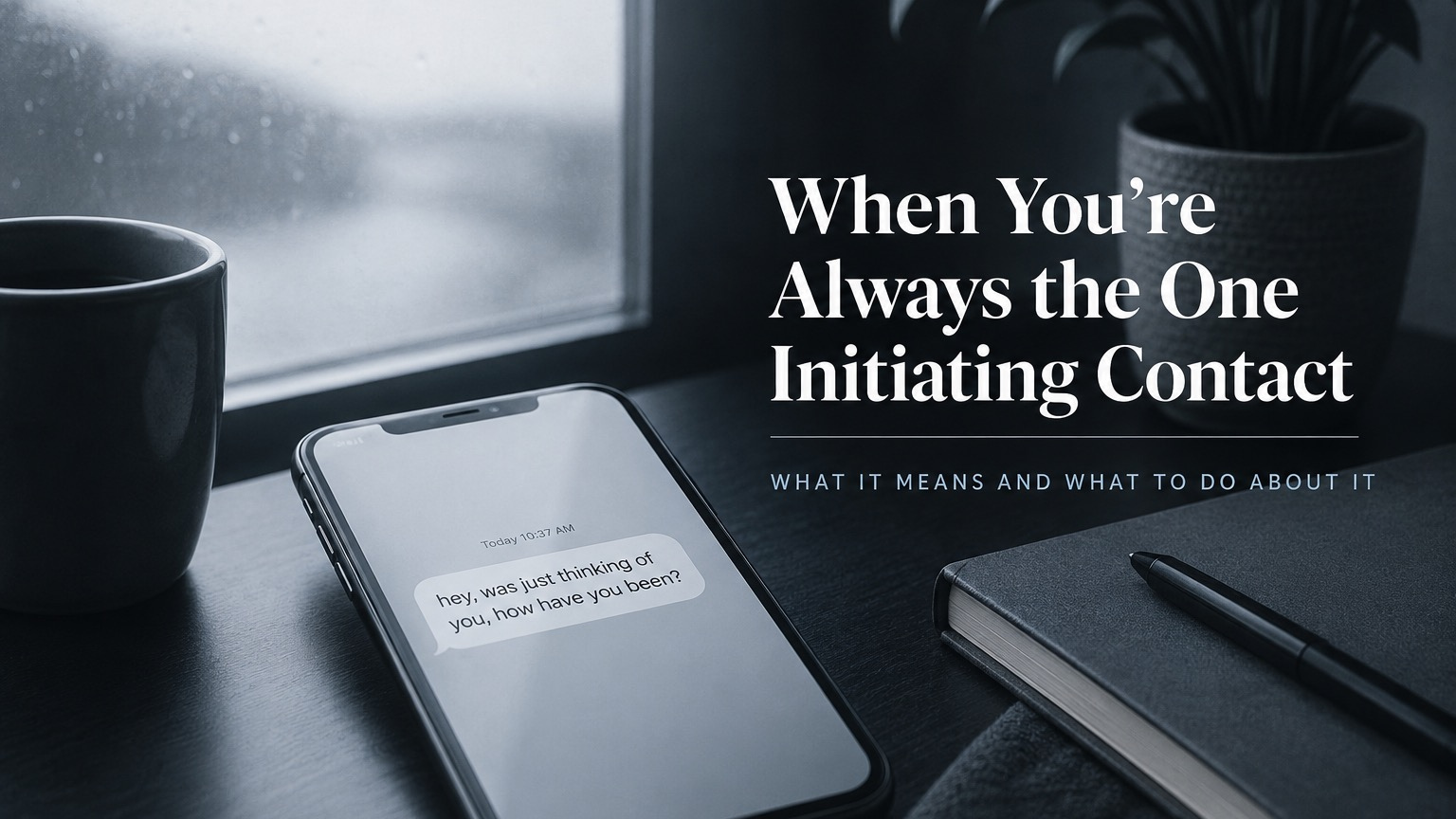
What does it mean when you are always the one initiating contact?
Not most of the time. Not slightly more than the other person. Always, or close enough to always that your phone history starts looking less like a conversation and more like a one-person newsletter.
This is where people get weirdly defensive. Someone will say, “Well, relationships should not be 50-50 all the time.” Correct. They should not. I do not need a spreadsheet where every text, call, meme, voice note, and “how was your day?” gets assigned to a column like we are auditing romance for the IRS.
Some people initiate more naturally than others. Some people are more outgoing, more verbal, more likely to walk into a room and say hello to strangers. That does not stop when they leave the room. It leaks into texting, calling, planning, checking in, and sending the random photo of something they saw because it made them think of you.
So no, contact does not need to be perfectly balanced. A 60-40 rhythm is great. Depending on the dynamic, even 70-30 or 80-20 can work. Some people are pursuers. Some people are responders. In early dating especially, men have traditionally done more of the initiating, and that is not some shocking new social discovery. That has been happening since the first guy nervously tried to impress a woman by dragging over a slightly above-average rock.
But 90-10 is different.
And 100-0 is not a relationship pattern.
It is a warning light.
In dating, this is the part men often miss and women tend to pick up on faster. If you are initiating almost all of the contact, she is probably not that into you. She may like you. She may enjoy hearing from you. She may even think she is interested. But if she almost never reaches out, almost never starts a conversation, almost never sends the “this made me think of you” text, her behavior is telling a clearer story than her words.
That sounds harsh because it is harsh.
But it is also useful.
People are not usually too busy for what matters to them. They may be overwhelmed. They may be tired. They may have difficult seasons. They may be juggling work, kids, family, health, anxiety, and the general modern joy of having 47 things screaming for attention at all times. Life is real, and compassion should be too.
But everybody has enough time to send a text.
The harder truth is that they are usually not failing to reach out because they have no time. They are failing to reach out because you are not crossing their mind in a way that moves them to action. That does not make them evil. It does not make you pathetic. It just means the interest is probably not where you want it to be.
And yes, there are exceptions. There are always exceptions. Someone will read this and say, “I barely initiate contact, but I care deeply about people.” Fine. That may be true. Somebody being born with one leg does not mean humans are not generally a two-legged species. Exceptions matter, but they do not erase the general pattern.
Generally, when someone is interested, they create contact.
It may not look exactly like your communication style. It may not come as often as you would prefer. But there will usually be signs of voluntary effort. A good morning text. A picture from their day. A random thought. A follow-up question. A little doorway opened from their side of the street.
If none of that is happening, you probably need to stop turning one crumb into a casserole.
I say that as someone who has absolutely turned crumbs into casseroles.
One of the reasons this cycle is hard to leave is that the rare moment of initiation feels amazing. If you always text first, and then one day they finally send something first, your brain lights up like you just won a small emotional lottery. Suddenly you forget the previous 99 times you carried the connection on your back like a sherpa of affection.
But the reason it feels so good is partly because it happens so rarely.
That is not a sign of health. That is a sign of scarcity.
Friendship is a little different, though. Friendship has more history, more context, and more strange little arrangements that form over time without anyone signing a contract. You may simply be the initiator in many of your friendships. You may be the planner, the organizer, the person who says, “Let’s get coffee,” “Let’s grab dinner,” “How are you doing?” or “Are we pretending we are not all aging rapidly, or should we hang out soon?”
Some people are natural connectors. If that is you, it can be a gift. You keep things alive. You build community. You are the person who makes sure the group does not quietly dissolve into everyone liking each other’s posts twice a year and calling it friendship.
But even gifts can become exhausting when nobody helps carry them.
If a friendship has always worked with you initiating 70 or 80 percent of the time, and the other person responds warmly, shows up, cares, remembers things, and makes effort in other ways, that may be fine. Not every friendship needs symmetrical communication. Some people show love by answering the call, not making it.
But if you are initiating 100 percent of the contact, planning everything, checking in every time, and the friendship disappears the moment you stop pushing it forward, then you have to ask the uncomfortable question.
Is this a friendship, or is this a friendship you are keeping on life support?
That does not mean you need to dramatically cut people off. Please do not turn every social disappointment into a press conference. Sometimes the best move is quieter. Step back a little. Stop initiating for a while. See what happens.
Not as a test in the manipulative sense.
More like an honest observation.
If you never text first, do they eventually reach out? If you stop planning, do they ever suggest something? If you stop carrying the whole connection, does anything remain standing?
The answer may hurt. But the answer is information.
You can also just tell the person. This is especially true with real friends. Say something like, “I know I’m usually the one who reaches out, but sometimes it would mean a lot if you initiated too.” You do not have to make it dramatic. You do not have to read them a 4,000-word victim impact statement while they are trying to order tacos.
Just be honest.
A real friend may not become a perfect initiator overnight. They may improve for a while, then slide back toward their natural pattern. That is human. But if they care, they will probably try. Even a little effort matters when the issue is effort.
The tricky part is that some people really are wired differently. They can go through most of a day without thinking to reach out, not because they hate you, but because their brain does not naturally move outward in that way. They may be focused, distracted, introverted, task-driven, emotionally compartmentalized, or just bad at relational maintenance.
Some of those people are also capable of incredible unselfishness. They may be the first person to show up when your car breaks down, your dad is sick, your life falls apart, or you need help moving something heavy and emotionally symbolic. They may not text much, but when the moment gets real, they are there.
So the question is not simply, “Do they initiate contact?”
The better question is, “Do they show mutual care somewhere?”
If they do not initiate, do they respond with warmth? Do they make time when you ask? Do they remember what matters to you? Do they show up when it counts? Do they make you feel valued, even if their communication style is different from yours?
If yes, you may just need to accept the unevenness or decide how much of it you can live with.
If no, then you may be chasing a connection that is giving you very little back.
And that is where self-respect has to enter the room.
Being the initiator is not a weakness. It may be one of the best things about you. The world needs people who reach out, plan dinners, send the text, check on friends, make the call, and refuse to let every relationship die of passive neglect.
But being the initiator does not mean you are obligated to be the entire relationship.
You are allowed to want effort back.
You are allowed to notice patterns.
You are allowed to stop begging for proof that someone values you.
The hopeful part is this: when you stop pouring all your energy into people who rarely reach back, you make room for people who do. You begin to see the difference between someone who is busy and someone who is absent. Between someone who is quiet and someone who is indifferent. Between someone who receives your effort with gratitude and someone who simply consumes it.
Not every relationship has to end because the balance is uneven.
But every relationship should have some evidence of mutual care.
So if you are the one always initiating, do not immediately shame yourself for caring more. Caring is not the problem. Effort is not the problem. Reaching out is not the problem.
The problem is when you keep offering presence to people who only offer availability when it is convenient.
Pay attention to who reaches back.
Pay attention to who tries.
Pay attention to who makes you feel like your effort lands somewhere human.
Then keep initiating where it is appreciated.
And where it is not, maybe give yourself permission to put the phone down, stop carrying the whole thing, and let silence tell the truth.


