Every family has its stories.
Some are about vacations. Some are about holidays. Some involve the time Uncle Whoever did something stupid 25 years ago and has been sentenced to hearing about it at Thanksgiving for the rest of his natural life.
My dad’s stories are almost always about basketball.
Actually, that’s not quite accurate. Almost any story my dad tells eventually becomes a basketball story. You can start a conversation about work, family, money, politics, the weather, or what somebody ordered for lunch, and somehow he’ll find the crossover dribble that gets us back to basketball.
“That reminds me of this basketball game…”
I’ve heard some of these stories hundreds of times. The details occasionally move around a little. Certain opponents improve considerably with age. Dad’s shooting percentages rarely decline.
I hope he tells them another hundred times.
Because somewhere along the way, I’ve realized the stories aren’t really about basketball. They’re about fathers and sons, and the peculiar ways we find to spend time together without ever stopping to announce that we’re spending time together.
For us, that place was always a basketball court.
My Dad Lived for Basketball
When I say my dad lived for basketball, you probably don’t quite understand what I mean.
Basketball wasn’t simply something he enjoyed. It was almost the organizing principle of his recreational life. There was always another YMCA league, city league, pickup game or tournament somewhere, and Dad had an uncanny ability to find it.
As he got older, basketball simply got older with him.
He played in over-40 tournaments, then over-50 tournaments, then over-60 and over-70 tournaments. A few years ago, he played in a national basketball tournament for players over 80.
And he wasn’t showing up for the commemorative T-shirt.
Dad could score.
Thirty-point games weren’t unusual. Eight or ten made three-pointers happened often enough that nobody seemed particularly surprised anymore. Age kept adding numbers to the front of the tournament division. It never quite figured out what to do with his jump shot.
Naturally, I grew up playing too.
My own basketball career didn’t unfold the way I once imagined. I had a lot of ability, but Tourette syndrome created significant problems during my teenage years. Then some underachieving, immaturity, and other issues in my early twenties helped finish off whatever basketball career might have been there.
That’s life.
Throughout my late teens and into my twenties, something interesting remained. Almost anywhere I played basketball, I was generally the best player on the court. I hardly ever lost pickup games, leagues or tournaments, and I walked into virtually every gym expecting to win.
Eventually, the dream I had built around basketball slipped away.
The game didn’t.
For years afterward, a basketball court still felt like familiar ground, a place where everything made sense once the ball started bouncing.
But before basketball was ever a dream I chased, it was something much simpler and, looking back, much more important.
It was the place where my dad and I spent so much of our lives together.
The Old Guy and His Little Boy
After Dad finished playing pickup basketball, he’d often look around the gym for two guys still hanging around.
Then came the proposition.
“Want to play me and my son?”
It sounded harmless enough.
It wasn’t.
Dad would suggest playing by twos and ones instead of threes and twos. That gave three-point shooters an enormous advantage, which happened to be convenient considering our entire offensive philosophy was basically: shoot threes.
We’d run ball screens at the top of the key. Then another screen. Then a back pick. Sometimes another pick after that. We’d keep screening for each other until somebody finally had enough daylight to launch one.
We didn’t want layups.
There were times we’d get all the way to the basket, have an easy shot, and kick the ball back outside because somewhere behind the three-point line was the shot we actually wanted.
The math was simple. If we made more than half our threes, and somehow we usually did, we were awfully difficult to beat.
For years, the best part was the sales pitch.
People saw an older guy and his little boy and figured they’d found an easy game.
Then the little boy kept making threes.
Eventually, I grew to 6-foot-7, and the gimmick lost some of its charm. Nobody looked at the giant standing next to Dad and thought, “Well, this seems easy.”
Dad still tried the pitch.
And we still played.
The Day Two of Us Beat Bowling Green
One of Dad’s favorite stories happened while I was at Bowling Green.
A fraternity was hosting a three-on-three basketball tournament. We entered with another player, except when it was time for our first game, our third player didn’t show up.
So there we were.
Dad and me.
Our first opponent?
Three players from the Bowling Green basketball team.
They were freshmen and sophomores, I believe a red-shirt or two, although that detail has become increasingly difficult to locate in Dad’s version of the story. If you hear him tell it today, you’d think we were facing Michael Jordan, Magic Johnson and Larry Bird.
One of their players was a lengthy, athletic freshman who stood close to seven feet tall. He started out guarding me and immediately decided he’d like to conduct an experiment.
He backed off and encouraged me to shoot, proclaiming he needed to see if I could hit the shot.
I did.
We were up 2-0.
He came down and threw down a dunk, which was considerably more spectacular than my jump shot and worth exactly half as many points.
2-1.
Next possession, he gave me another one, this time from a couple of feet behind the three-point line, he again proclaimed that he needed to see if I could make it from there.
I made that too.
4-1.
They came back with another dunk.
4-2.
At this point, his teammates apparently concluded that the experiment had produced sufficient data.
They switched him onto my dad.
Dad promptly made a three.
6-2.
That was basically the game.
They were bigger, younger, more athletic and considerably more impressive around the rim. We kept trying to funnel them toward one-point shots while running our collection of screens and launching threes.
They dunked.
We shot threes.
They dunked again.
We shot another three.
Eventually, the game ended with Dad and me winning, I believe 16-12.
Two against three.
My dad and his little boy had beaten a few guys from the Bowling Green basketball team.
That is where Dad always ends the story.
The tournament was double elimination, and we eventually recruited some random guy from the weight room who hadn’t really played basketball to become our third player. Somehow, we kept winning and reached the championship.
Waiting for us was Bowling Green again.
Except their roster had undergone what I can only describe as a very aggressive mid-tournament recruiting campaign.
This time, the team was mostly juniors and seniors. They even added a former Bowling Green player who had played professionally and had NBA tryouts. Apparently, eligibility rules at fraternity three-on-three tournaments were fairly fluid.
Then some other rules mysteriously changed.
Instead of playing to 16, we were playing to 21. Instead of twos and ones, we’d use threes and twos, reducing our three-point advantage. And despite this supposedly being double elimination, suddenly we wouldn’t get a second game if we lost.
We played them close anyway, this time with our third player joinig us on the court, but shots were tough to come by, they played a tough physical game and had a much better game-plan this time around.
They beat us by a couple of points.
Tournament over.
Dad almost never mentions any of that.
And frankly, I don’t blame him.
“That time we beat the Bowling Green basketball team two-on-three” is a much better story.
The Hoop It Up Championship
Another favorite came when we played Hoop It Up.
This time, we couldn’t exactly claim to be innocent underdogs. One of my brothers-in-law had played Division I college basketball. Our friend Chris had also played Division I basketball.
We had a legitimate team.
Rain delays forced the tournament organizers to shorten the championship game to 11 points. With baskets worth twos and ones, there wasn’t much room for a slow start.
Fortunately, I didn’t have one.
I hit three straight three-pointers to start the game.
Six-nothing.
And I reacted with the calm maturity you’d expect from a young man who understood there was still almost half a basketball game left to play.
In other words, I completely lost my mind.
I was dancing. Celebrating. Talking. Probably acting like we’d just won something significantly more important than a three-on-three tournament.
My teammates called our only timeout.
Not to discuss defense.
Not to draw up an offensive set.
They needed to calm me down.
We were up 6-0, but apparently tournament officials were still going to require us to score the other five points.
The other team came back, and the game got tight.
Eventually, my brother-in-law found himself falling backward near half court with essentially no shot available. So he launched a very long three while falling onto his back.
It went in.
We won Hoop It Up.
Dad loves telling that story, although I suspect the part where everyone had to use our only timeout to settle me down gives him nearly as much pleasure as the championship.
The Day We Beat Two NBA Players
Then there is perhaps the best one.
One afternoon, after playing some five-on-five pickup basketball, Dad managed to talk Danny Ferry and Bob Sura into playing us three-on-three.
Yes.
Those Danny Ferry and Bob Sura.
Both were active NBA players at the time.
By pedigree, there wasn’t much debate about who should have been favored. They were NBA players.
But resumes don’t actually check into pickup games.
At that point in my life, I was playing about as well as I’d ever played. Throughout my late teens and twenties, I had become accustomed to walking onto basketball courts and being the best player there. I rarely lost, and I certainly didn’t step onto that court believing I was outmatched.
In all fairness, at that particular moment, on that particular court, I felt like I was every bit as good as either of them.
Maybe better.
The basketball world certainly wouldn’t have agreed.
That was fine with me.
Our third player was our friend Fred, who had never played organized basketball but was incredibly quick, could shoot, and understood our strange little system perfectly.
So we did what we’d always done.
Screens.
Back picks.
Ball screens at the top of the key.
More screens.
Then another one, just in case.
We’d turn down layups and kick the ball back outside. Our goal was to shoot almost exclusively from behind the three-point line while encouraging them to keep taking one-pointers.
Defensively, Dad wasn’t exactly going to lock down an NBA player, which meant I had to cover a lot of ground. But strategically, the system worked.
They took ones.
We took twos.
And we beat them pretty handily.
I remember Danny Ferry not taking the loss particularly well.
Fortunately for us, that meant they agreed to play again.
The second game was different. They’d figured out what we were doing, and Bob Sura guarded me instead of Ferry. Sura was an excellent defender, and he made it much harder for me to score.
The game was significantly closer.
But the system eventually prevailed again.
We won.
Two games.
Dad immediately tried talking them into a third.
That wasn’t happening.
Danny Ferry’s father, Bob Ferry, was there watching that day. He had been an NBA executive, which somehow adds another little layer to Dad’s version of the story.
Because now it wasn’t simply that we beat two active NBA players.
There was a legitimate NBA basketball man there to witness the whole thing.
I’m reasonably certain Danny Ferry and Bob Sura don’t remember any of this.
For them, it was probably one random offseason afternoon playing basketball.
For my dad?
It became family history.
The 72-Point Game That Dad Remembers Differently
The fourth story might be the most perfectly “Dad” story of them all.
We were playing in a full-court four-on-four YMCA league. Our team was supposed to include Dad, me, one of my former high school teammates and a fourth player.
Except we didn’t have a fourth player.
Without one, we’d have to forfeit.
Dad wasn’t forfeiting a basketball game because of something as trivial as not having enough basketball players.
So he found another stockbroker he knew at the YMCA who was, I believe, around 70 years old.
There was one small issue.
He couldn’t really run up and down the court.
No problem.
We didn’t need him to run.
We needed him to technically exist.
So our newly acquired fourth player stayed primarily on the defensive end while my former high school teammate and I essentially turned the game into a track meet.
We ran.
And ran.
And ran some more.
We pressured the ball, created steals, sprinted the floor and scored layup after layup. Four-on-four full-court basketball can become ridiculously high scoring when you have players willing to keep running.
We scored somewhere around 130 or 140 points and won by about 40.
I scored 72.
Now, 72 points sounds more impressive than it is.
Don’t misunderstand me. It’s still a lot of points. It’s the most I’ve ever scored in a basketball game. But in that particular full-court four-on-four league, 72 was probably more like scoring 50 in a traditional five-on-five game.
Still pretty good.
Just not Wilt Chamberlain.
Dad scored 24 points.
All on three-pointers.
Eight threes.
Eight attempts.
He did not miss.
So naturally, when Dad tells the story of the game in which his son scored 72 points and we may have set the league scoring record…
He remembers going eight-for-eight.
But even that isn’t his favorite part.
What he really remembers is the approximately 70-year-old stockbroker he recruited from the YMCA to stand on one end of the basketball court so we wouldn’t have to forfeit.
That’s the part that still makes him laugh.
And maybe that’s why I love hearing him tell it.
The Stories Were Never Really About Basketball
I haven’t played serious basketball in many years.
These days, I’ve traded jump shots for ultramarathons. Instead of figuring out how to get open behind another screen, I spend an unreasonable amount of time figuring out how to move forward for 100 or 200 miles.
Life takes you strange places.
But lately, watching my dad and thinking about all those tournaments he played, the over-40s, over-50s, over-60s, over-70s and eventually over-80s, I’ve started wondering whether I might eventually give senior basketball a shot myself.
Maybe I’ll see if there’s still something left in the jumper.
Maybe I’ll chase a few scoring records Dad may or may not actually hold.
Maybe I’ll discover that my knees strongly prefer ultramarathons, which would be a fairly alarming development.
But maybe there are still a few basketball stories left.
Because the older I get, the more I understand what those stories actually are.
For some fathers and sons, it’s playing catch in the front yard. A baseball goes back and forth hundreds of times while almost nothing important seems to be happening.
Except something important is happening.
For others, it’s fishing. Working on cars. Golfing. Hunting. Going to football games. Maybe it’s some little tradition that doesn’t look significant enough to deserve a photograph or a journal entry.
For us, it was basketball.
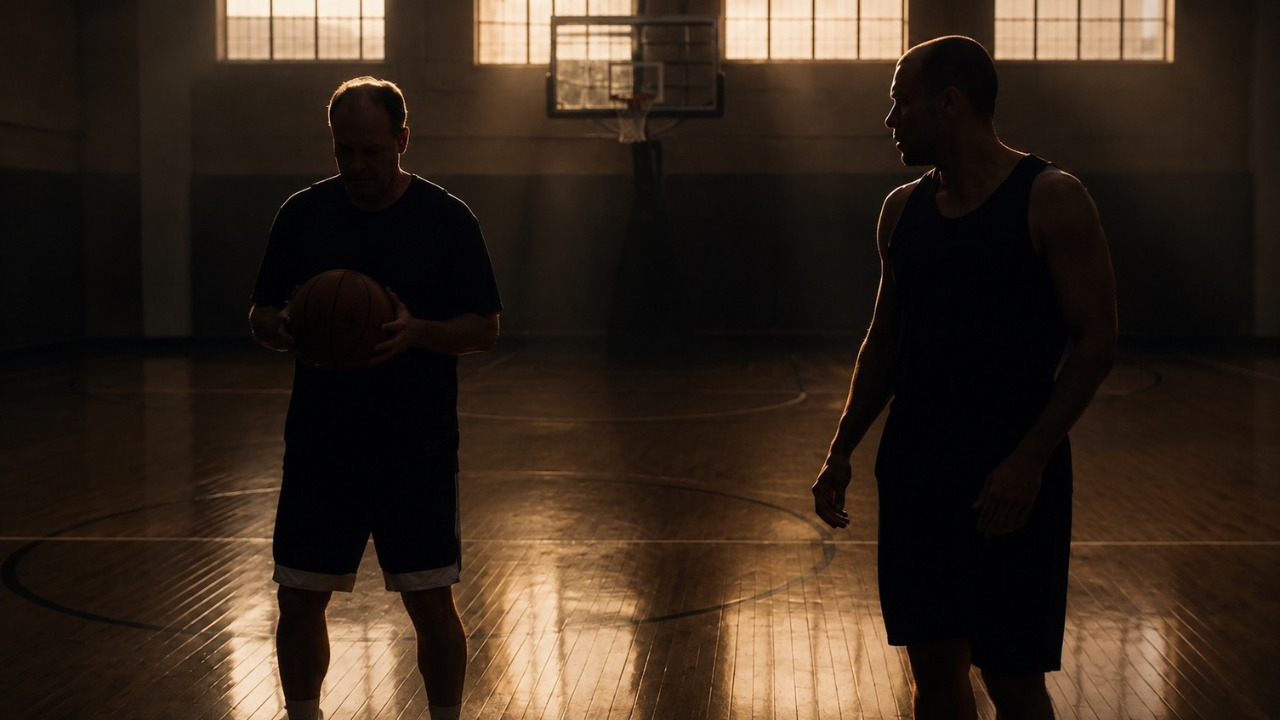
A ball echoing through an empty gym. Shoes squeaking across hardwood. Dad behind the three-point line, me setting another screen, both of us trying to steal one more game before it was time to go home.
That’s how a lot of fathers and sons build a life together.
Not through grand moments. Not by stopping to recognize that something important is happening.
They just play.
They compete.
They laugh.
They ride home.
And somewhere along the way, ordinary afternoons quietly become the memories that matter most.
My dad has spent most of his life telling basketball stories. Bowling Green. Hoop It Up. Danny Ferry and Bob Sura. The game where he went eight-for-eight while his son happened to score 72 points.
No matter where a conversation begins, he can usually find his way back to one of them.
“You know, that reminds me of this basketball game…”
I’ve heard that sentence most of my life.
It took me years to understand that what followed was never really about basketball.
It was his way of remembering us.
A father and a son.
A ball.
A court.
A few ridiculous wins.
A lot of three-pointers.
And thousands of hours that neither of us understood, at the time, were becoming something we would someday give almost anything to step back into for just one afternoon.
Maybe that’s why I never get tired of hearing the stories.
Because every time Dad tells one, for a few minutes, time gives something back.
I’m still his little boy.
He’s still calling for one more screen.
The gym is still open.
The ball is still in his hands.
And there’s still time for one more game.


