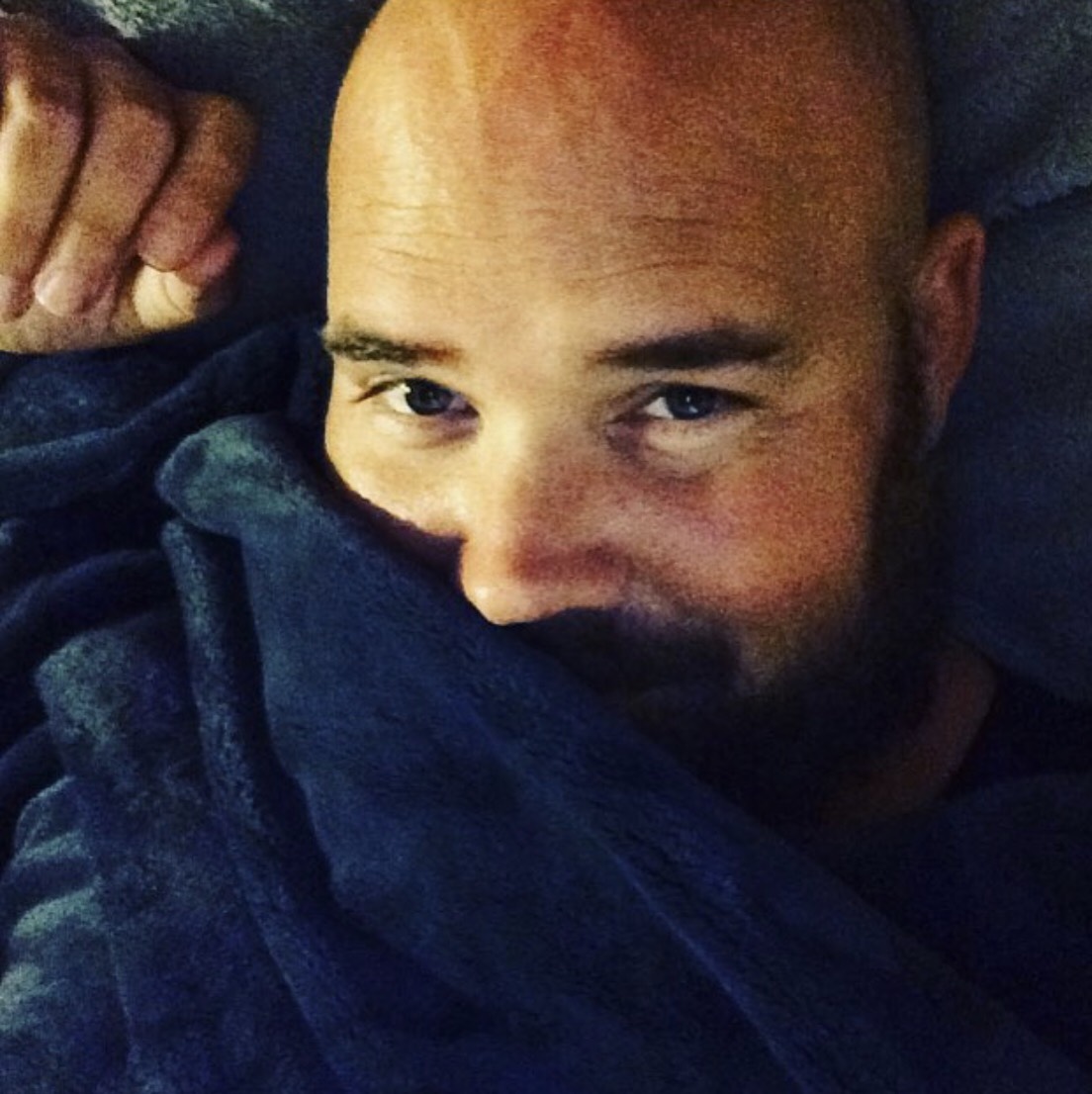
My mother has dementia. She is in the final stages. She no longer knows who I am, not really, but she knows I am someone familiar. Someone she loves, and someone who loves her.
Recently, a new tic has developed—my left shoulder jerks forward. My tics are always worse when I am tired or stressed. My last visit with my mom, I was both. My shoulder shook.
She noticed. Then, she started copying the movement. Maybe she thought I was dancing and decided to dance with me from her wheelchair. Or maybe, somewhere in the deep, fading corners of her mind, a mother saw her little boy shaking—six foot seven, 260 pounds now—and she joined in, so I wouldn’t feel alone.
A Life Shaped by Tourettes
I was diagnosed with Tourette Syndrome young, especially for the late 80s when early diagnoses were rare. My parents had been getting reports that I was disrespectful at school. It didn’t make sense—I was a well-behaved kid.
At the time, I had a loud throat-clearing tic, another where I’d randomly repeat the time, and one where I frequently looked down. I still have all three today, though the vocal tics are now rare and the throat-clearing one is barely noticeable.
My teacher thought I was doing it on purpose. Thought I was mocking her.
So my parents took me to one of the world’s top neurologists at the Cleveland Clinic. I was diagnosed with Tourette Syndrome. Immediately, they put me on heavy medication. That started a ten-year phase where I was whoever the medicine made me.
What is Tourette Syndrome?
Tourette Syndrome (TS) is a lifelong neurological disorder with no known cause and no known cure. It involves uncontrollable, repetitive movements or unwanted sounds—tics. It often coexists with other neurological conditions: ADHD, anxiety, depression, bipolar disorder, OCD.
Contrary to how it’s often portrayed, involuntary swearing or shouting obscene things is rare, affecting only a small percentage of people with TS.
The Weight of Medication
I grew up in a loving and supportive family. They were educated on TS and deeply involved in my treatment. But for me, treatment mostly meant medication.
Each new pill came with side effects, requiring another pill to counter them. A medication would work for a year or so, then lose effectiveness, and I’d be switched again.
I couldn’t tell you who I was as a child. Outgoing. Shy. Life of the party. Loner. Happy. Sad. Talkative. Quiet. I was all of them at different times. I was none of them at all. I was whoever the medicine made me.
A Moment That Changed Everything
Fifth grade was rough. That was the year I was first hospitalized for suicidal thoughts. I was ten. The solution? More medication. I think lithium was one of them.
I only remember being exhausted. I had been a standout athlete, always moving, always playing. That year, I stopped. I wasn’t interested in sports. I wasn’t interested in anything.
I changed. And my classmates noticed. I lost friends.
My parents, working with the school, decided to hold a presentation on Tourette Syndrome for my entire class. Maybe they thought understanding would bring acceptance.
But it was 1990. Nobody had heard of Tourette’s. A year later, the movie What About Bob? came out, and suddenly, Tourettes was a punchline.
The presentation ended, and they opened the floor for questions.
A kid named Tony raised his hand. Will he die from it?
The nurse answered, No.
Tony shrugged. Darn it.
Everyone laughed.
That was the moment I understood. I might get support from my family. A few close friends. But outside of that, I was alone.
A Life on Borrowed Time
My teenage years were difficult. I was always a standout in sports, especially basketball, but outside of that, I don’t remember many happy moments beyond time with my family and my best friend, Aaron.
Inside my home, my childhood was good. Outside of it, I was miserable.
I was always surrounded by people—my big family, my teammates, my castmates in theater—but I always felt alone.
The battle never ended. I never won. I never told anyone how I felt. From my first counseling appointment at age seven, I learned that if I said the right things, people would let me go back to being alone.
Once, I turned my closet into a little refuge—pillows, blankets, a light. I wanted to be as far from the world as I could.
Through my teens, the answer to everything seemed to be try a different medication. I was hospitalized twice for depression. Once, I held a knife to my throat. My twin sister pried it from my hands, grabbing the blade itself.
I don’t remember that. Or the behaviors that led me to the hospital. I only know what I’ve been told.
As an adult, I can look back and see that wasn’t really me. That was the medication. But as a kid, I had no sense of identity. I was whoever the drugs shaped me to be.
We were searching for a magic combination—a way to control my tics, my thoughts, my emotions, while still letting me be me.
We never found it.
Breaking Free
After a particularly rough year, I turned eighteen and made a decision. I stopped taking my medication. Cold turkey.
I was told I wouldn’t function. That I couldn’t function. That I’d come crawling back.
I didn’t. I went to college.
The first semester was brutal. I had a roommate. I overloaded my schedule. I tried to do everything, be everything, and I struggled.
But then, I found myself.
For the first time, I excelled in school. I excelled in sports. I excelled socially.
I met the most beautiful, popular girl on campus, and she became my wife. I got involved in church, led Bible studies, won every leadership award the school had to offer.
Life was great. The difference?
I was off medication. I was free.
I learned that Tourette’s didn’t limit me. That I could succeed without medication. That I could be alone most of the time, let my tics go wild, and still be productive in short bursts.
When I stuck to that, life was good. When I strayed, life was very bad.
Finding Peace in the Tics
If I am tired, stressed, or anxious, my tics are worse. Tasks take longer. Interaction becomes impossible.
So I hide. Shelter myself away when I know my tics won’t be controllable. It happens more often than not.
Oddly, those times—when my head jerks, when my shoulder shakes so much my arm goes numb—are when I am most at peace.
I don’t fight it. I let the tics come. I feel weightless. Free.
When you see a cheerful text from me, a happy post—it’s often in those moments. Ticking away, alone, but content.
The thing is, I’ve never figured out how to be productive during those times. Or how to include others.
Not my ex-wife. Not any girlfriend since. Not my family. Not my friends.
That time, when I feel most at peace, I am always alone. I know no other way.
Shaking a lot tonight. Alone.
This is my life.
Still smiling.

 Life, Liberty and the Pursuit of Pizza
Goodmorning KP. You have always impressed and intrigued me. Now even more. You are beautiful tics and all.
LikeLike
Awesome Mr. Kelly. My first time visiting and reading a post on your blog. I was watching a movie in which a guy had the tourette syndrome and I could not continue watching the movie. Just the mere thought of somebody actually living in reality with such a syndrome was incredibly shocking. I pray God to strengthen you and make you bigger. I celebrate you. Mr. Kelly you are a heroe.
LikeLike
Glad to read that you are still smiling!
LikeLiked by 2 people
Mmmm…are you really alone? I bet you anything… God is right there with you.
We are made in His image, we are perfect just the way He wants us. God bless you KP_Kelly
🙂
LikeLiked by 1 person
I had the same question. I have found that I am truly never alone. It’s been through those difficult journeys that I found HIS promise to never leave me to be true. For me, I would say my greatest growth has come when being alone, yet never alone.
I REALLY like your writings and will be following. My mom has dementia… interesting journey as I see God in it with us.
LikeLiked by 1 person
Wow. That was very honest and revealing and touching. Thanks for sharing that. I hope you’re finding your balance in life.
LikeLiked by 1 person
What a remarkable, courageous, and highly influential man you are for typing your thoughts and feelings. I am certain you are helping and inspiring many others who are experiencing mild or serious afflictions like you described in dealing with TS. Tic, smile, be happy and carry on with your life the way you know best. If your thoughts should ever go in the opposite direction when you’re alone, please have the fortitude to reach out to your family, friends, Followers, or me to have a better outcome.
LikeLiked by 1 person
Thank you for sharing your struggle KP. Wishing you all the best in the future.
LikeLiked by 1 person
KP,
We are never alone, neither are you. You’re awesome. Keep smiling.
LikeLiked by 1 person
Thank you for sharing. Great expression and inspiration for others.
LikeLiked by 1 person
Thank you!
LikeLike
Good afternoon,
I stumbled upon your post and continued reading. I admire your positive attitude! It’s also sad at the same time. I know the feeling of isolation too well! In a nutshell I’m a survivor of childhood abuse by my father who was a narcissistic functioning drug addict and alcoholic. I was the chosen one from age 4 to 23 physically yes 23. I ended up in abusive relationships and in and out of therapy, meds etc. I’m 52 still functioning I’m a 6 year cancer survivor praise God! I’m a woman of faith without God idk where I’d be. I have four kids all adults and eight grandchildren. I’m medically retired from the cancer and treatment damage. I have good days and bad days good few and far between. You’re not alone in that feeling. I was not allowed to be in any activites whatsoever, no friends allowed so I grew up not trusting or bonding with “friends ” I’m married now three years, but still struggle since my husband is an ordained minister my illness is from the enemy?! I have a great relationship with the Lord hand in hand. If you saw me you’d never know I have been through anything. I’m attempting to write a book but going in circles with it. Anyhow I was intrigued by your story. I pray God wraps his loving arms around you! God bless you brother! 💝🙏
LikeLike
I am glad you stumbled upon my blog. Thank you for reading and commenting. Have a great week!
LikeLike
As a fellow Tourette’s sufferer, I appreciate your candor and honesty. Thank you for sharing-God bless!
LikeLiked by 1 person
What a beautiful story on being content with Gods creation…you!
Bless you my friend in Christ!
LikeLiked by 1 person
Here is a link to a proven herbal study to help with Tourette’s & tics. https://plantmedicines.org/tcm-herbs-beat-drug-tourettes/
LikeLike