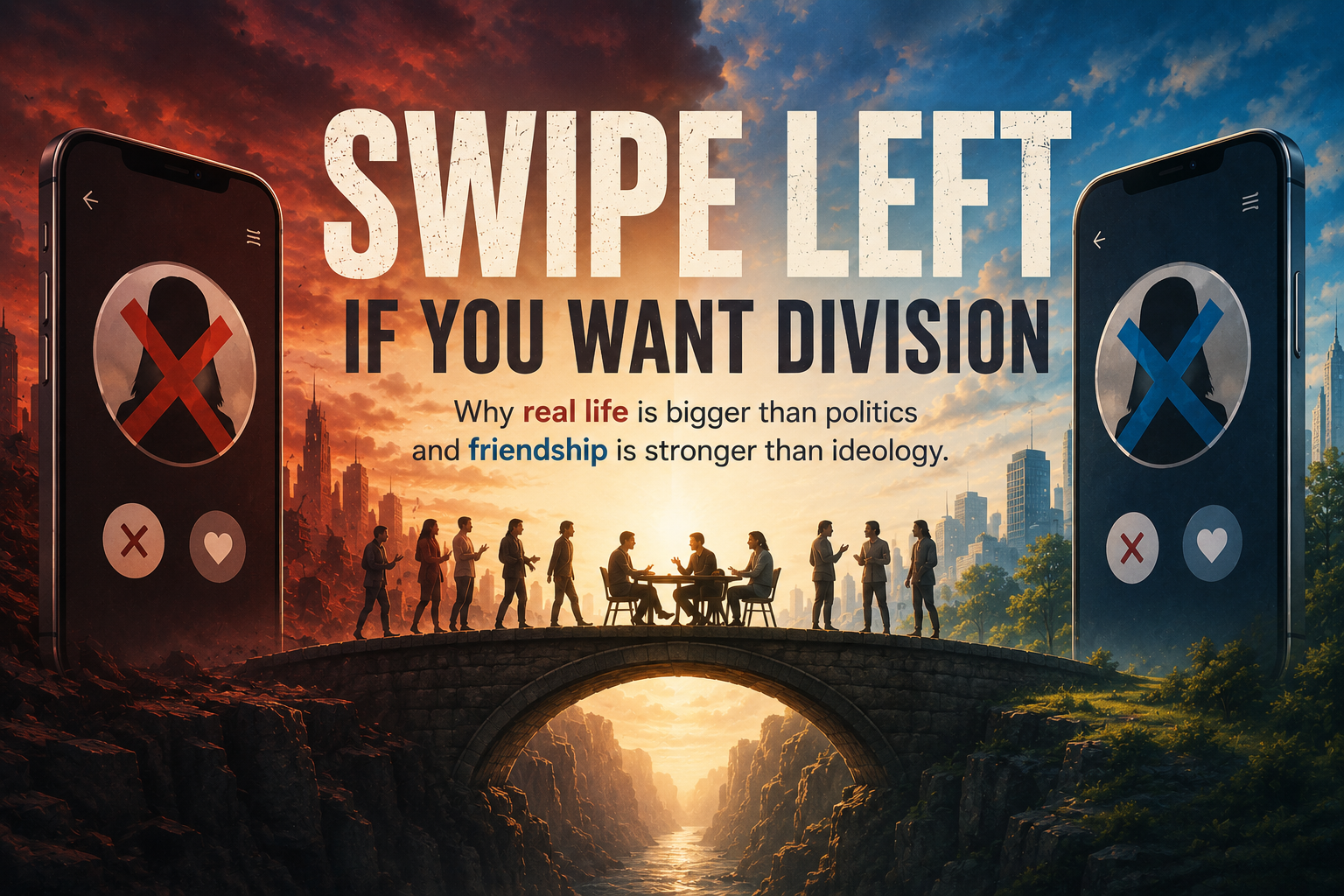
Somewhere along the way, people started confusing political disagreement with personal incompatibility.
Dating apps have become a fascinating sociology experiment that prove this.
Swipe left if you voted for Trump.
Swipe left if you voted for Harris.
Swipe left if you are MAGA.
Swipe left if you are not MAGA.
Swipe left if you think pineapple belongs on pizza.
Okay, that last one might actually be reasonable.
Political affiliation stopped being one characteristic about a person and became, for many people, the entire sorting mechanism for human worth.
Which is strange, because when I look around my actual life, not the internet version of life, I see something very different.
Confession: my best friend is a Democrat. Even worse, he is a Lakers fan. Somehow, despite me being a conservative Celtics fan, we have managed to maintain a friendship.
I have friends on the left. Friends on the far left. Friends on the right. Friends on the far right. A handful of moderates, though those seem increasingly endangered.
And when I strip away the headlines, the rage bait, the cable news theater, and the algorithmically engineered outrage designed to keep us doom scrolling at 1:17 in the morning, I notice something revealing.
Most people kind of want the same things.
Safety.
Opportunity.
Community.
Purpose.
A decent life.
A future for their kids.
A chance to keep enough of what they earn to breathe a little.
A society that functions at least slightly better than the comment section under a political Facebook post.
The disagreements are often about implementation.
Who should pay for what.
How large government should be.
What tradeoffs are acceptable.
What risks are worth taking.
What role institutions should play or not play.
Those are real disagreements. Important disagreements. Worth debating.
But they are not proof that the other side is evil.
And somewhere in the modern political era, we lost the ability to separate disagreement from moral condemnation.
Every election now feels like a hostage negotiation with people posting graphics explaining why civilization will immediately collapse if the other side wins. Then half the country wins, half the country loses, everybody posts dramatic statuses for a week, and somehow society continues lumbering forward anyway.
Messily.
Imperfectly.
Like humans always have.
Political parties themselves are constantly shifting too. Beliefs that once made someone a Democrat now get labeled conservative. Voting blocs move. Priorities change. Coalitions evolve. People act like political identity is some fixed eternal truth handed down from a mountain carved into stone tablets by George Washington himself.
It is not.
And yet people keep treating each other like extensions of whichever politician they voted for four years ago.
That part fascinates me.
Because I have had moments talking with friends where I think, “How in the world did this person vote differently than I did?” Then I step back and remember I already know this person.
I know they are kind.
I know they show up for people.
I know they care about their family.
I know they want good things for the people around them.
I know they would help me if my life fell apart tomorrow.
At that point, the disagreement becomes a lot less apocalyptic.
It becomes human.
Some of the strongest friendships come from people challenging each other a little. Different perspectives can sharpen us if we let them. A world where every person thinks exactly like you sounds less like enlightenment and more like being trapped at dinner with yourself forever.
No thank you.
We also selectively obsess over political differences in ways that border on parody.
Nobody says:
“I could never date someone who listens to country music.”
“I refuse friendship with people who think The Office is overrated.”
“If you prefer pancakes over waffles, unmatch immediately.”
But politics?
Instant exile.
A person can be loyal, generous, hilarious, dependable, thoughtful, and emotionally mature, but if they checked the wrong box in November, suddenly they are treated like a morally contaminated science experiment.
The media deserves some blame for this. So do social media algorithms. Rage keeps people engaged. Fear keeps people clicking. “Your neighbor might vote differently than you” is not exactly a ratings machine. “Your neighbor is an existential threat to democracy itself” performs much better.
And people absorb that messaging slowly over time.
Then one day they wake up unable to separate an actual human being from the loudest political caricature on television.
That is dangerous.
Not because disagreement is dangerous.
Disagreement is healthy.
Dehumanization is dangerous.
Most relationships are not built on voting records anyway. They are built on smaller things. Showing up. Loyalty. Humor. Shared struggle. Checking in when life gets hard. Being able to sit across from someone at dinner and enjoy their company without needing to audit every political opinion they have ever held.
That is real life.
And maybe we should get back to valuing that a little more.
Because eventually the election signs come down.
The hashtags fade.
The outrage cycle resets itself onto something new.
But your actual relationships?
Those are the things that remain.
Protect those more carefully than your political tribe.

 Life, Liberty and the Pursuit of Pizza